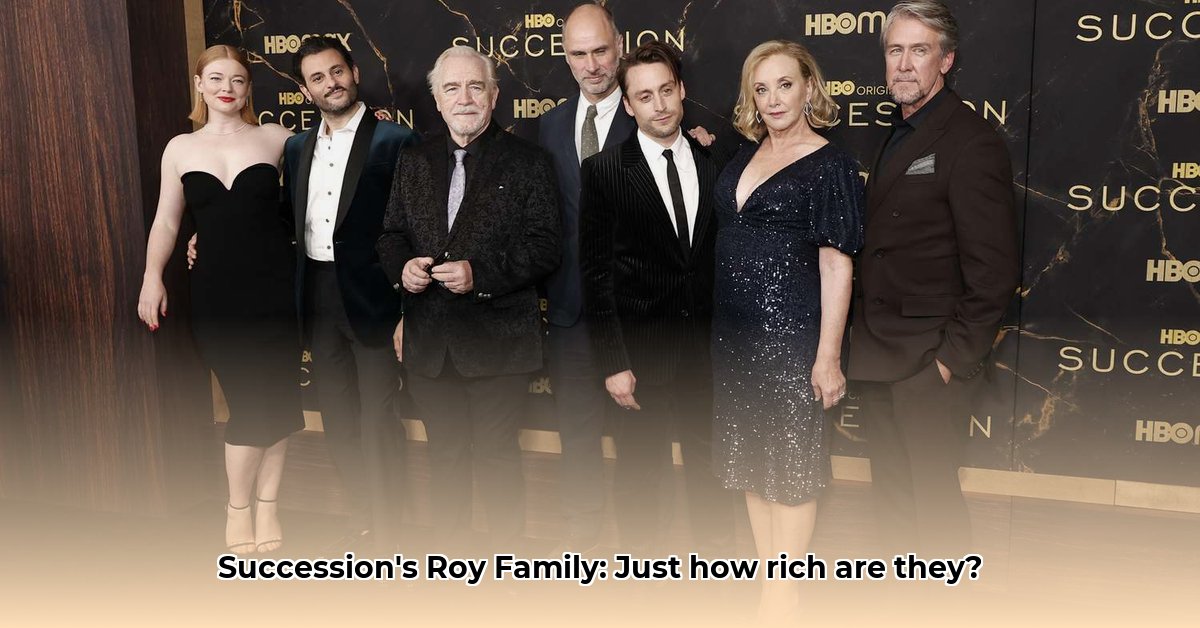
Unraveling the Roy Fortune: A Billion-Dollar Enigma
HBO's Succession has captivated audiences with its portrayal of the ultra-wealthy Roy family and their cutthroat battle for control of Waystar RoyCo. But just how much are the Roys worth? This isn't a simple question to answer, even within the fictional world of the show itself. The family's fortune is a complex tapestry woven from shifting asset valuations, opaque business dealings, and the family's own carefully cultivated mystique. This article will delve into the conflicting estimates surrounding the Roys' net worth, exploring the challenges of valuing a fictional empire and utilizing clues from the show itself to paint a more complete, albeit still imprecise, picture. For a deeper dive into the topic, check out this Roy Family Net Worth analysis.
Waystar RoyCo: The Foundation of a Fortune
The core of the Roy family's wealth is indisputably Waystar RoyCo, their sprawling media conglomerate. While Logan Roy's ownership stake hovers around 36% according to various analyses, the valuation of the company itself is surprisingly volatile. Even in the real world, assessing the value of a large, multifaceted corporation is a challenging task involving nuanced financial modeling. Imagine the added complexity of evaluating a fictional empire with constantly shifting market positions and deliberately obscured financials. The resulting discrepancies in estimations are significant, creating a wide range of potential values for the family's collective worth.
Conflicting Estimates: A Billion-Dollar Gap
Different analysts have arrived at drastically different figures for Waystar RoyCo's valuation, leading to hugely divergent estimations for the Roy family's overall net worth. One prominent estimate places Waystar's market value at approximately $46 billion, implying a Roy family stake of roughly $18 billion. However, other analyses project a far higher valuation for Waystar, reaching as high as $67 billion, which would place the Roy family's net worth at an astounding $24 billion. This massive discrepancy underscores the inherent difficulties in valuating a fictional entity, especially one as carefully shrouded in mystery as Waystar RoyCo.
Beyond Waystar: Hidden Assets and Unspecified Holdings
The substantial discrepancies in net worth estimates also stem from factors beyond Waystar's fluctuating valuation. Experts attempt to account for the family's extensive real estate portfolio, which includes opulent properties spanning continents. Think sprawling New York City penthouses, sprawling English country estates, and luxurious Malibu beachfront mansions. The maintenance costs of these properties alone are staggering, adding further weight to the overall valuation. Yet, even factoring in these substantial assets, significant variations in estimations persist. Unaccounted-for assets – private jets, investments in sports teams, or potentially, even undisclosed offshore accounts – further complicate the picture and add to the intrigue. The show itself deliberately obscures the family’s full financial reality, enhancing the suspense and mirroring the power struggles within the family itself.
The Mattson Factor: A Game-Changing Acquisition
The looming acquisition of Waystar RoyCo by the ambitious tech mogul Lukas Mattson introduces yet another layer of uncertainty. The price Mattson might offer, and the consequent impact on the Roys' overall net worth, remains entirely speculative. This potential deal dramatically underscores the inherently volatile nature of family wealth, highlighting its continual evolution influenced by external economic factors, strategic decisions, and, importantly, unpredictable events. The episode serves as a reminder that calculating net worth is not a static process, but rather a continuous evaluation of assets in a fluid market.
Fact vs. Fiction: The Challenges of Valuation
The struggle to precisely determine the Roy family's net worth is ultimately rooted in the nature of the show itself. This is not simply a matter of accessing publicly available financial documents. Instead, we rely on fragments of information extracted from dialogue, visual cues, and often intentionally ambiguous plot lines. This carefully crafted ambiguity is, of course, a crucial element of the show's dramatic tension. The inherent uncertainty mirrors the characters' anxieties, power struggles, and the insecurity of their positions, increasing the intrigue of the plot.
Integrated Analysis: Key Insights from our Research
- Valuation Volatility: The fluctuating valuation of Waystar RoyCo is the primary driver of the wide discrepancies in net worth estimates.
- Hidden Assets: The significant portion of the Roys' wealth represented by their vast and largely unseen assets further complicates any attempt at precise estimation.
- Dynamic Wealth: The potential Mattson acquisition perfectly illustrates the fluid and dynamic nature of the Roy family's net worth, impacted by external unpredictable factors.
Actionable Intelligence: Applying the Lessons Learned
- Context Matters: When evaluating fictional wealth, remember that context is key. The show's narrative choices and stylistic decisions must be incorporated into any valuation analysis.
- Comparative Analysis: While not a perfect match, comparison with real-world media families such as the Murdochs and Gettys can provide valuable context, while acknowledging significant differences.
- Embrace the Ambiguity: Accepting that pinpointing a precise number is impossible is crucial. The ambiguity surrounding the Roy family’s wealth is itself a critical element of Succession's narrative success.
The continued debate surrounding the Roys' exact net worth, therefore, serves not merely as a number-crunching exercise, but as a compelling reflection of the show's complex narrative and the inherent challenges of accurately assessing wealth in both fiction and reality. The true value of this analysis lies not in arriving at a definitive figure, but in understanding the limitations of estimations based on incomplete and often ambiguous data.